
 listicle
Durable Rash Guards for Gym: Top Picks for 2026
Table of Contents
- Quick Comparison: Durable Rash Guards for Gym
- What Actually Makes a Gym Rash Guard Durable
- Top Durable Rash Guards for Gym Training
- Moisture Wicking Rash Guards for Women: Fit and Sizing Guide
- How to Wash Gym Rash Guards So They Last
- Skin Sensitivity, Fabric Allergies, and Eco-Friendly Materials
- Conclusion: Choosing the Right Durable Rash Guard
- Frequently Asked Questions
Last Updated: September 30, 2026
Quick Comparison: Durable Rash Guards for Gym
Durable rash guards for gym training survive repeated friction, sweat, and washing without losing shape or print.

The short answer: fit and fabric weight matter more than branding.
Here is the quick verdict before the details:
| Product | Price | Sleeve | Best For |
|---|---|---|---|
| All-Over Print Men's Rash Guard | $46.50 | Short | High-frequency lifters |
| Men's Rash Guard | $53.50 | Long | Grappling and no-gi work |
| Women's Rash Guard | $44.50 | Long | Women who want a fitted cut |
What Actually Makes a Gym Rash Guard Durable
Durability in a gym rash guard comes down to three things: how the seams are sewn, how heavy the fabric is, and how well the stretch recovers. Get those right and the garment survives hundreds of wash cycles; get them wrong and you replace gear every season.

Most cheap rash guards fail at the seams, not the fabric. "Durable" is not a single property, it is a chain of failure points, and the garment is only as strong as the first one to give out.
The Four Failure Points, In Order of How Often They Break
When a rash guard dies, it almost always dies in this sequence:
- Seam thread abrasion, the thread wears through before the fabric does, usually at the underarm gusset and the shoulder seam where friction concentrates.
- Spandex fatigue, the elastic fibers lose recovery, so the garment goes slack at the elbows, waist, and neckline even though the fabric itself is intact.
- Fabric pilling and thinning, abrasion against barbell knurling, mats, and bench pads thins the weave until it goes translucent.
- Print or dye failure, surface prints crack and flake; dye-sublimated prints bonded into the fiber do not.
A failure at step one is a seam problem; at step two, a fiber-blend problem. Knowing which tells you whether the garment was cheaply made or just worn out.
Flatlock Stitching and Reinforced Seams
Flatlock stitching joins fabric edges flat rather than folded over, so it sits flush against your skin and chafes less during grappling, mat work, or high-rep training.
Flat seams reduce friction, avoiding the raw spots that show up after long sessions, and distribute stress across more thread so they resist pulling apart when the fabric stretches. Coverstitched hems on the sleeves and body reinforce the points that take the most abuse.
Turn a rash guard inside out to inspect it: raised, bulky seams will rub and wear faster. Pull the underarm seam gently, a well-built flatlock stretches with the fabric and snaps back without the thread going taut and shiny. Glossy or frayed thread is already on its way out.
Fabric Weight and Abrasion Resistance
Fabric weight, measured in grams per square meter, tells you how much material you are getting. Heavier fabric resists abrasion better, holds its shape longer, and feels more substantial.
A rash guard in the 230 g/m² range is a solid middle ground: thick enough to resist mat burn and friction without trapping too much heat. Lighter fabric dries faster but wears through sooner, especially on rough mats or with a barbell resting against your torso.
The fiber blend matters just as much. A polyester and spandex mix gives four-way stretch, and that recovery keeps a rash guard from going baggy at the elbows and waist. Watch spandex content: too little and the garment loses shape, too much and it feels restrictive and breaks down faster under heat.
How to Stress-Test a Rash Guard Before You Commit
You cannot simulate three months of training in a fitting room, but a five-minute check predicts most failures:
- The pull test: grip the fabric at the chest and pull it wide, then release. It should snap back flat within a second. Slow recovery means the spandex is already tired.
- The light test: hold the fabric up to a light source. If you can see through the weave at the shoulders and chest, it will thin out fast under abrasion.
- The seam tug: pull the underarm and shoulder seams apart gently. Visible thread gaps or a shiny, strained thread mean the seam is the weak link.
- The print check: scratch the print lightly with a fingernail. If color lifts or flakes, it is a surface print, not a dye-sublimated one.
Top Durable Rash Guards for Gym Training
The best durable rash guards for gym training combine flatlock seams, a fitted cut, and a fabric blend that recovers after every session. Here are some men's options, each built for a different training style.
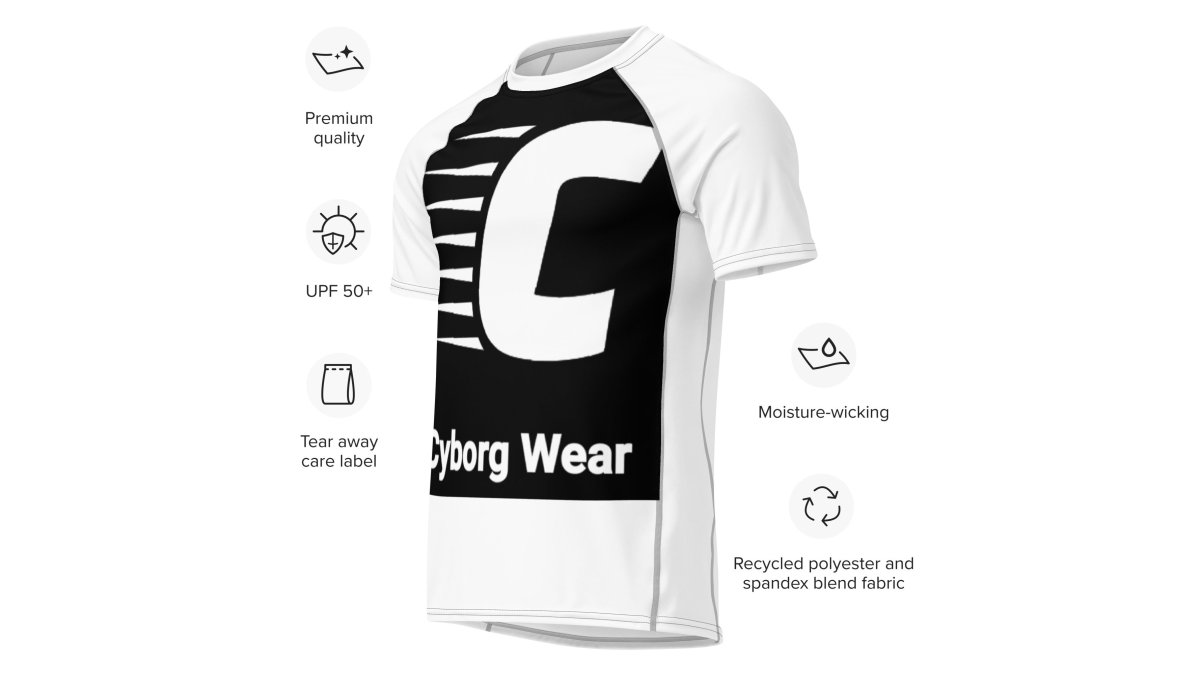
All-Over Print Men's Rash Guard: Best for High-Frequency Lifters
If you lift four or more days a week, this is the pick: the fitted cut stays close through every rep, with no loose fabric catching on benches or barbells.
The fabric is 81% recycled polyester and 19% spandex at 7.52 oz./yd.², heavier, which is what you want for abrasion resistance. Flatlock seams sit flush, and UPF 50+ protects your skin outdoors.
The all-over print separates this from a plain training top, and the fabric carries OEKO-TEX 100 and Global Recycled Standard certification.
All-over print men’s rash guard →
What works: The heavier fabric and fitted cut hold up to daily wear. The print does not rely on a surface coating that flakes off.
What does not: The fitted cut runs snug, so size up if you prefer room through the chest.
Men's Rash Guard: Best Long-Sleeve Option for Grappling
For no-gi grappling and mat work, the long-sleeve Men's Rash Guard is the stronger choice. Full sleeve coverage protects your arms from mat burn and friction during scrambles.
Moisture Wicking Rash Guards for Women: Fit and Sizing Guide
Moisture wicking rash guards for women must pull sweat away from the skin and stay put through movement. The Women's Rash Guard features a fitted design and a stretch-recovery fabric blend.

How to Wash Gym Rash Guards So They Last
How you wash gym rash guards decides how long they last. Heat and harsh detergent break down spandex fibers and fade prints faster than training ever will, here is the mechanism behind each habit.
Why Heat Is the Real Enemy
Spandex is a polyurethane-based fiber held under tension. Heat above roughly 140°F relaxes that tension permanently, the fibers stay stretched instead of springing back. That is why a rash guard that repeatedly goes through a hot dryer goes slack at the elbows and waist even though the fabric looks fine.
The Wash Routine That Protects the Seams
- Turn the rash guard inside out before washing, this puts the abrasive cycle against the inside face, not the print
- Use cold water on a gentle cycle
- Skip fabric softener, which coats the fibers and reduces wicking
- Wash with similar colors to avoid dye transfer
- Air dry flat or hang, never in a hot dryer
- Keep away from velcro, which snags fabric in the wash
- Use a mesh laundry bag if you wash gear with zippers, hooks, or drawstrings
The biggest mistake is tossing a rash guard in a hot dryer. Heat is what kills the stretch, and once spandex loses its recovery, the fit goes slack and stays that way.
Between-Wash Habits That Extend Gear Life
Rinse the garment in cold water right after training to stop odor from setting in. If you train twice a day, a quick cold rinse and hang-dry between sessions often gets two wears out of one wash cycle, half the wash-and-dry wear on the seams.
When to Retire a Rash Guard
Even with perfect care, a rash guard has a service life. Retire it when the fabric goes translucent at the shoulders, the underarm seams develop visible gaps, or it no longer snaps back after a gentle pull, past that point it stops doing the compression and moisture-wicking job you bought it for.
Skin Sensitivity, Fabric Allergies, and Eco-Friendly Materials
Skin sensitivity matters if you react to certain fabrics or dyes. If your skin is prone to irritation, look for rash guards with certified fabric and flat seams that reduce friction.
Conclusion: Choosing the Right Durable Rash Guard
Picking a durable rash guard comes down to matching construction to how you train. High-frequency lifters want a heavier short-sleeve fabric with a fitted cut. Grapplers want long sleeves and four-way stretch. Everyone benefits from flatlock seams and cold-water care.
OEKO-TEX Standard 100 explanation
Textile Exchange Global Recycled Standard
American Academy of Dermatology guidance on skin irritation
Frequently Asked Questions
What makes a rash guard durable for gym training?
Durability comes down to three things: flatlock stitching that won't unravel under tension, fabric weight (look for 230 g/m² or higher), and a spandex or elastane blend that recovers its shape. Rash guards with reinforced seams and four-way stretch hold up better against repeated stretching, abrasion from equipment, and frequent washing than basic cotton alternatives.
Are long-sleeve or short-sleeve rash guards better for the gym?
Long-sleeve rash guards offer more coverage for grappling, mat work, and outdoor training, protecting against friction and UV exposure. Short-sleeve options work well for weightlifting and general gym sessions where you want less fabric. Both styles from CYBORG WEAR feature flatlock seams and UPF 50+, so the choice depends on your training type and how much skin coverage you prefer.
How do you properly wash and maintain a rash guard?
Turn the rash guard inside out and wash in cold water on a gentle cycle. Skip fabric softener, which clogs the moisture-wicking fibers. Air dry instead of using a dryer to prevent heat damage to the spandex blend. Following these steps keeps the fabric's four-way stretch and moisture-wicking properties intact through dozens of wash cycles.
Do rash guards prevent skin infections in the gym?
Rash guards create a barrier between your skin and shared equipment, reducing direct contact with bacteria that can cause skin infections. The moisture-wicking fabric pulls sweat away from your body, which helps keep skin drier. For best results, wash your rash guard after every session and avoid leaving damp gear in a gym bag.