 listicle
High Performance Rash Guards for Men: 2026 Top Picks
Table of Contents
- Quick Comparison: Top High Performance Rash Guards for Men
- How We Evaluated These High Performance Rash Guards
- 1. All-Over Print Men's Rash Guard: Best Overall
- 2. Men's Rash Guard: Best for Surfing and Sun Protection
- Moisture Wicking Rash Guard Benefits for Intense Training
- Compression Shirt vs Rash Guard: What's the Difference?
- How to Wash BJJ Rash Guards Without Fading Prints or Trapping Odors
- Conclusion
- Frequently Asked Questions
Last Updated: September 17, 2026
Quick Comparison: Top High Performance Rash Guards for Men
The best high performance rash guards for men combine UPF 50+ protection, four-way stretch, and flatlock seams that prevent chafing during long sessions. This guide from CYBORG WEAR breaks down the two strongest options in our lineup, then covers the fabric science, care, and fit details that actually matter.

Quick Picks:
- Best Overall: All-Over Print Men's Rash Guard ($46.50), recycled fabric, bold prints, UPF 50+
- Best for Surfing: Men's Rash Guard ($53.50), long sleeves, ergonomic seams, four-way stretch
| Product | Price | Fabric | Best For | Sleeves |
|---|---|---|---|---|
| All-Over Print Men's Rash Guard | $46.50 | 81% recycled polyester, 19% spandex | Gym, beach, cycling | Short |
| Men's Rash Guard | $53.50 | 82% polyester, 18% spandex | Surfing, sun protection | Long |
How We Evaluated These High Performance Rash Guards
We scored each rash guard on four criteria: fabric composition, seam construction, fit range, and how the print holds up after repeated washing. Fabric carried the most weight. A rash guard is only as good as its stretch and recovery, so we prioritized garments with a spandex or elastane content high enough to move with the body without sagging.

1. All-Over Print Men's Rash Guard: Best Overall
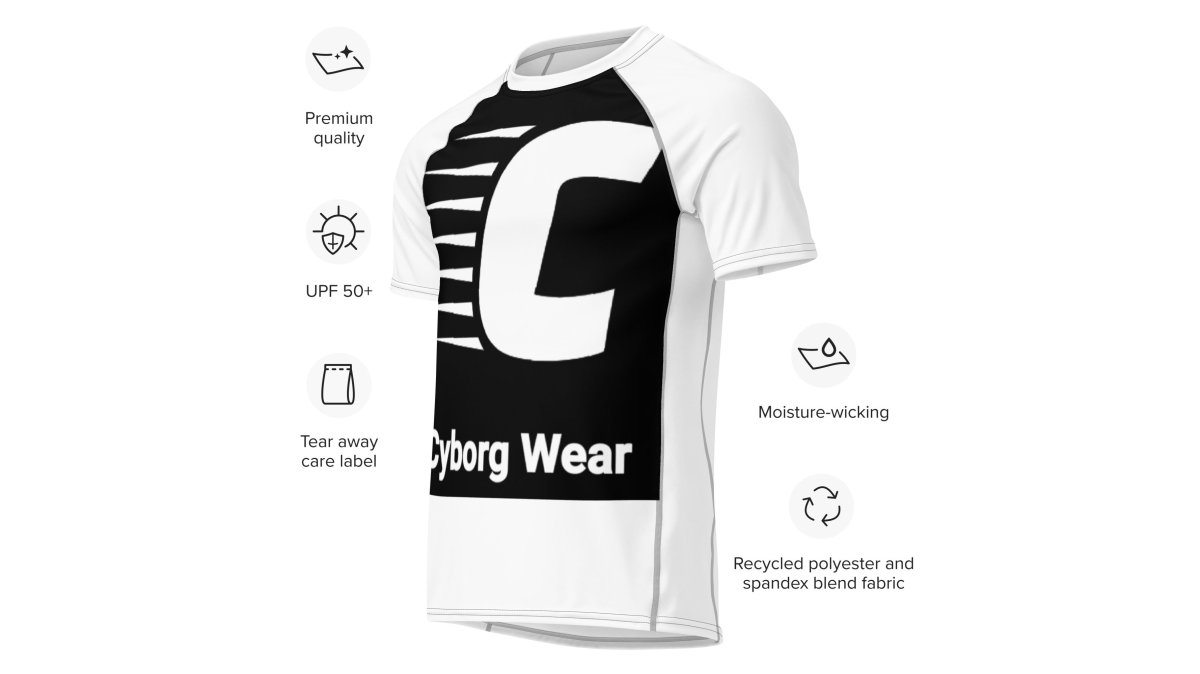
This is the rash guard we recommend to most men. At $46.50, it delivers a fitted cut, moisture-wicking fabric, and UPF 50+ protection in one package. The US version uses 81% recycled polyester and 19% spandex, giving it the four-way stretch that keeps the garment moving with you rather than against you.
Pros and Cons
Pros:
- Recycled polyester blend with 19% spandex for genuine four-way stretch
- UPF 50+ protection for outdoor training
- Extended sizing up to 6XL
- Print-forward design that works outside the gym
Cons:
- Short sleeves leave forearms exposed to sun
- Made-to-order production means a longer delivery window
- Fitted cut runs snug; size up if you prefer room
2. Men's Rash Guard: Best for Surfing and Sun Protection
Long sleeves change the equation for water sports. This $53.50 rash guard uses 82% polyester and 18% spandex, with a body and sleeves cut slightly longer than a standard tee for extra coverage. That extra length is the detail most people miss until they're paddling out and their shirt rides up.
Pros and Cons
Pros:
- Long sleeves and extended body for full coverage
- Four-way stretch that recovers on both grains
- Flat ergonomic seams reduce chafing
- UPF 50+ for extended sun exposure
Cons:
- Higher price than the short-sleeve option
- Slim fit leaves little room for layering underneath
- Limited to XS-3XL, narrower than the print line
Moisture Wicking Rash Guard Benefits for Intense Training
A moisture wicking rash guard pulls sweat away from the skin and spreads it across the fabric surface, where it evaporates faster than it would sitting on your body. That matters more than most people realize during high-output training and in humid conditions.
The practical benefits stack up quickly:
- Thermal regulation: Dry fabric against the skin keeps body temperature steadier than soaked cotton.
- Rash prevention: Less trapped moisture means less friction, which is the root cause of most chafing.
- Odor control: Sweat that evaporates doesn't sit in the fabric breeding bacteria.
- Breathability: Hydrophobic fibers move vapor out instead of holding it in.
Compression Shirt vs Rash Guard: What's the Difference?
A compression shirt is built to squeeze; a rash guard is built to protect. That single distinction drives everything else, from fabric weight to how tight the garment fits, and, more importantly, to which cut actually works for your body.
| Feature | Compression Shirt | Rash Guard |
|---|---|---|
| Primary purpose | Muscle support | Rash and sun protection |
| Typical fit | Tight, high compression | Fitted to slim |
| Common use | Lifting, recovery | Surfing, BJJ, MMA, swimming |
| Sun protection | Rarely rated | Often UPF 50+ |
| Seam style | Flatlock or bonded | Flatlock, coverstitch |
Compression Fit vs Loose Fit: Which Cut Fits Your Body Type
Most guides stop at "fitted vs loose" and leave you guessing. The cut you choose should follow your build and your sport, not the other way around.
- Lean and tall frames: A compression fit keeps fabric from bunching at the waist and riding up under a wetsuit. Look for at least 18% spandex so the hem stays put through repeated pull-overs.
- Broad shoulders and thick chests: A slim-fit rash guard with a slightly longer body cut prevents the shirt from pulling up at the midsection. If the shoulder seam sits past the edge of your shoulder, size down, the extra fabric will chafe under a board or gi.
- Stockier builds or anyone carrying weight through the midsection: A looser, straight-cut rash guard reduces the squeeze across the ribs and belly, which is where compression garments tend to roll and dig during long sessions. Prioritize a cut with a straight hem rather than a tapered one.
- Long torsos: Extended-body rash guards (the kind cut longer than a standard tee) matter more than sleeve length. A shirt that rides up mid-paddle exposes the lower back to sun and rash.
When to Choose Each
If you train no-gi, surf, or snorkel, choose a rash guard. If you lift and want support under a tee, a compression shirt does the job. If you do both, a fitted rash guard with a compression-style cut covers the most ground, it protects on the mat and holds shape under a lifting session without the aggressive squeeze of a dedicated compression top.
How to Wash BJJ Rash Guards Without Fading Prints or Trapping Odors
Cold water, inside out, and no fabric softener. That's the short version, and it solves most print fading and odor problems before they start. But the reason odor clings to rash guards, and the reason anti-microbial treatments matter more in combat sports than in surfing, is worth understanding before you build a wash routine.
Why Rash Guards Trap Odor (and What Anti-Microbial Treatments Do)
Synthetic fabrics like polyester and spandex are hydrophobic: they don't absorb water the way cotton does. That's exactly what makes them wick sweat. The trade-off is that oils and bacteria from skin and mat contact cling to the fiber surface instead of rinsing away, and once bacteria colonize those oils, a normal wash cycle doesn't always dislodge them. That's the "clean shirt that still smells" problem.
The Wash Routine That Keeps Prints and Fabric Intact
BJJ and MMA rash guards take a beating: mat contact, heavy sweat, and frequent washing. Here's the routine that keeps them in rotation:
- Rinse within an hour of training. Cold water, no soap, just to flush sweat before it sets into the fiber.
- Turn the garment inside out. This protects the print surface from abrasion against other items.
- Wash cold on a gentle cycle. Hot water breaks down spandex and dulls dyes.
- Skip fabric softener entirely. It coats hydrophobic fibers, kills moisture wicking, and strips anti-microbial finishes.
- Hang dry or tumble low. High heat is the fastest way to shrink a rash guard and crack a print.
Layering Under a Wetsuit: What Changes
If you're layering a rash guard under a wetsuit for cold-water sessions, the care rules shift slightly. A rash guard worn as a base layer sits against your skin for hours and traps more body oil than a standalone top, so rinse it the same day, every time. And check the seams: a flatlock or coverstitch seam that's starting to fray will chafe far worse under neoprene than it would on its own, so retire the piece once the stitching goes.
Conclusion
Finding high performance rash guards for men comes down to matching fabric and construction to how you actually train. A rash guard built for the mat won't serve a surfer, and a sun shirt won't hold up in no-gi.
Frequently Asked Questions
What makes a rash guard 'high performance'?
A high performance rash guard combines four things: UPF 50+ sun protection, moisture-wicking fabric that pulls sweat off your skin, flatlock or ergonomic seams that prevent chafing, and a four-way stretch material that moves with you. Fabric composition matters too. Look for a polyester-spandex blend, like the 81% recycled polyester and 19% spandex used in CYBORG WEAR's all-over print rash guards, which balances stretch, durability, and quick-dry performance.
Should a rash guard be tight or loose?
A rash guard should fit snug against your skin without restricting movement. A fitted cut keeps the fabric in contact with your body so moisture-wicking works properly and the material doesn't bunch up under a wetsuit or gi. If it feels like a compression shirt, that's normal. If it's so tight you can't raise your arms, size up. CYBORG WEAR's rash guards use a fitted cut with four-way stretch to stay close without limiting range of motion.
Do rash guards protect against UV rays?
Yes. Most high performance rash guards carry a UPF rating, which measures how much UV radiation passes through the fabric. UPF 50+ blocks about 98% of UV rays, making it the highest rating available. CYBORG WEAR's rash guards are rated UPF 50+, so they work as sun protection for surfing, swimming, and long outdoor training sessions where sunscreen alone would wash or sweat off.
How do I care for my high performance rash guard to prevent odors?
Rinse your rash guard in cold water immediately after training, then machine wash cold on a gentle cycle with mild detergent. Skip fabric softener because it coats the fibers and reduces moisture-wicking. Hang dry instead of using a dryer, which breaks down spandex over time. For BJJ rash guards, wash after every session and avoid letting them sit damp in a gym bag, since that's where odor-causing bacteria multiply fastest.
Are long sleeve or short sleeve rash guards better for training?
It depends on your sport. Long sleeve rash guards give more sun protection and reduce mat or board rash on your forearms, which is why they're standard for surfing and no-gi grappling. Short sleeve rash guards run cooler and give your arms more freedom, making them a better pick for gym workouts, bike rides, and warm-weather training. Many athletes keep both and rotate based on the session.
Stop guessing whether your gear will survive the next wash cycle. Shop CYBORG WEAR's rash guard collection and train in apparel built to hold its fit, its print, and its protection.