 how-to
Is a Rash Guard Supposed to Be Tight?
Last Updated: October 23, 2026
Quick Summary
Yes, a rash guard supposed to be tight, but not uncomfortably so. The ideal fit is snug and body-hugging, almost like a second skin, allowing full freedom of movement while keeping fabric from bunching up and reducing friction against your skin.
- A snug rash guard should feel like it hugs your body with no wrinkles or loose fabric anywhere.
- Chest measurement is the most important number for rash guard sizing and ensures the garment stays in place.
- Signs of too-tight fit include pulling seams, restricted breathing, circulation issues, and shoulder seams riding up toward your neck.
- A loose rash guard creates bunching, gaps between fabric and skin, and sliding sleeves that increase chafing rather than prevent it.
- Do a movement test by raising your arms, twisting your torso, and doing squats to confirm proper fit before committing.
Table of Contents
- Is a Rash Guard Supposed to Be Tight?
- How Should a Rash Guard Fit
- Rash Guard Size Guide: Choosing the Right Size
- When Your Rash Guard Is Too Tight
- When Your Rash Guard Is Too Loose
- Compression, Comfort, and Freedom of Movement
- Rash Guard Fit for Different Activities
- Practical Fit Test You Can Do at Home
- Frequently Asked Questions
Is a Rash Guard Supposed to Be Tight?
Yes, a rash guard supposed to be tight, but not uncomfortably so. The ideal fit is snug and body-hugging, almost like a second skin.
The confusion comes from the word "tight." Many people assume tight means restrictive or uncomfortable.
Below, we'll walk you through exactly how to find that sweet spot between snug and comfortable, how to measure for the right size, and what to do if your rash guard doesn't fit quite right.
How Should a Rash Guard Fit
A rash guard should fit close to your body without excess fabric pooling anywhere.
The key is balance. A rash guard that's too loose defeats its purpose. Excess fabric will bunch up during movement, create friction against your skin, and shift around on the mat or in the water.
Snug vs. Loose: Finding the Balance
The difference between snug and too tight comes down to comfort and function.
A loose rash guard, on the other hand, will have visible gaps between the fabric and your skin.
The compression from a properly fitted rash guard actually enhances performance.
Many people confuse compression with restriction. A compression fit supports your muscles and keeps fabric where it belongs.
Rash Guard Size Guide: Choosing the Right Size
Getting the right size is the foundation of proper fit. Most rash guard fit problems come from choosing the wrong size in the first place. Here's how to find your size accurately.
Using Your Measurements
Measure your chest, waist, and hips while standing relaxed. Don't pull the tape tight or leave it loose, just snug enough that it sits flat against your skin.
For men's rash guards, chest measurement is the primary sizing reference. For women's rash guards, you'll typically use chest and waist measurements together.
Here's what a proper measurement process looks like:
- Chest: Measure around the fullest part of your chest, keeping the tape parallel to the ground
- Waist: Measure around your natural waist, typically where your pants sit
- Hips: Measure around the fullest part of your hips
Once you have these measurements, match them to the size chart. If your measurements fall between sizes, choose the size that matches your chest measurement most closely.
Testing Before You Commit
If you're ordering online, read the reviews carefully. Look for feedback from people with similar body types to yours. Do they mention how the fit runs, true to size, small, or large? These real-world insights are invaluable.
When your rash guard arrives, try it on and do a movement test immediately. Put it on and:
- Raise both arms overhead slowly
- Twist your torso left and right
- Do a few squats or lunges
If the fabric bunches, gaps form, or you feel restricted, the size isn't right. Most brands offer returns or exchanges, so don't settle for a poor fit.
When Your Rash Guard Is Too Tight
A rash guard that's genuinely too tight will show specific warning signs. The most obvious is discomfort. If you feel squeezed across your chest or shoulders, or if the fabric digs into your armpits, the size is wrong.
Signs Your Rash Guard Doesn't Fit Right
Watch for these specific problems that indicate your rash guard is too snug:
- Pulling at the seams: Seams should lie flat. If they're pulling or puckering, the garment is too small
- Restricted breathing: You should never feel like you can't take a full breath
- Circulation issues: Your arms shouldn't feel numb or tingly. If they do, the fit is cutting off blood flow
Prevention and treatment of exercise-related skin injuries notes that improper clothing fit is a common cause of friction-related skin problems during athletic activity. A rash guard that's too tight increases friction and can contribute to chafing and irritation.
If you notice any of these signs, size up. A larger rash guard that fits properly will perform better than a smaller one that's uncomfortable.
Watch for these specific problems that indicate your rash guard is too snug.
| Problem | What It Means |
|---|---|
| Pulling at the seams | Garment is too small |
| Restricted breathing | Cannot take a full breath |
| Circulation issues | Arms feel numb or tingly |
| Shoulder seams riding up | Seams sit on neck instead of shoulder point |
| Sleeves too short | End above wrist, need larger size |
| Visible bulging | Fabric bunching at sides or back |
When Your Rash Guard Is Too Loose
A loose rash guard creates different problems. The fabric will shift during movement, bunch up, and create friction against your skin. This actually increases chafing rather than preventing it.
Signs your rash guard is too loose include:
- Visible wrinkles or folds in the fabric when you're standing still
- Gaps between the fabric and your skin, especially at the sides or back
- Sleeves that slide up when you raise your arms
A loose rash guard also won't provide the compression benefits that make rash guards valuable. You lose the skin protection and the body-awareness advantage that comes from a snug fit.
If your rash guard is too loose, size down.
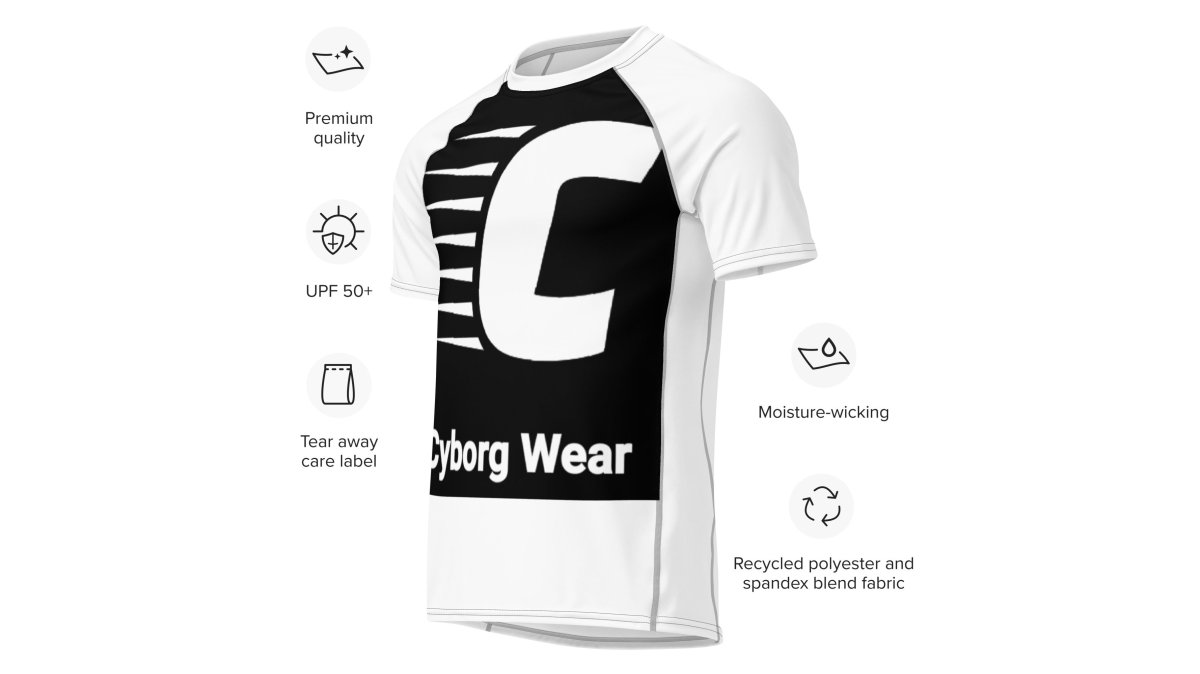
All-over print men’s rash guard →
Compression, Comfort, and Freedom of Movement
The best rash guard fit balances compression with comfort. Compression is what keeps the fabric in place and protects your skin. But compression only works if the garment fits snugly.
How Fabric Stretch Affects Performance
Rash guard fabric needs to stretch. Most quality rash guards use a blend of polyester and elastane (also called spandex).
The amount of stretch matters. A fabric that stretches in multiple directions, what's called four-way stretch, moves with your body better than one that only stretches in one direction.
This stretch allows you to move freely without the fabric feeling restrictive. When you raise your arm, the fabric stretches with you.
Fit Changes After Washing
Your rash guard's fit will change slightly after washing. Most rash guards shrink a little with repeated washing, especially if you use hot water or a dryer. To maintain the fit:
- Wash in cold water
- Air dry whenever possible
- Avoid high heat
If you're ordering a rash guard online, account for potential shrinkage. Some people size up slightly to account for this, but most quality rash guards are designed to maintain their fit through normal care. Follow the care instructions that come with your specific rash guard.
Rash Guard Fit for Different Activities
The ideal rash guard fit varies slightly depending on what you're doing. A rash guard for grappling has different demands than one for water sports.
Training, Grappling, and Combat Sports
For Brazilian jiu-jitsu, MMA, and other grappling sports, your rash guard needs to be snug so it doesn't get grabbed or snagged by your training partner.
The snug fit also matters for skin protection. During grappling, your body is in constant contact with the mat and your opponent.
For these activities, you want the snuggest comfortable fit. The fabric should feel like a second skin.
Water Sports and Beach Use
For swimming, surfing, and water sports, the fit requirements are slightly different. You still want a snug fit to prevent bunching, but the compression demands are lower.
A rash guard that's slightly less snug than what you'd wear for grappling can work fine for water sports. The water actually helps keep the fabric in place. However, you still shouldn't choose a loose fit.
Practical Fit Test You Can Do at Home
Before committing to a rash guard, do this simple fit test. It takes five minutes and tells you everything you need to know.
Put on the rash guard and do each of these movements:
-
Arm raises: Slowly raise both arms straight up overhead. The fabric should move with you without bunching. Seams should stay in place.
-
Torso twists: Twist your upper body left and right, keeping your hips still. The fabric should twist with you. No wrinkles should appear.
-
Squats: Do 10 slow squats. The rash guard should stay in place at your shoulders. The seams shouldn't ride up or down.
-
Grappling simulation: If you train in combat sports, simulate a grappling position. The fabric shouldn't bunch or gap anywhere.
-
Shoulder check: Raise your arms to the side and check your shoulder seams. They should sit right on your shoulder point, not up on your neck or down on your upper arm.
If all five movements feel comfortable and the fabric stays in place, you've found the right fit. If any movement creates bunching, gaps, or discomfort, the size isn't right.
The goal is a rash guard that feels like part of your body.
Guidelines on protective athletic wear and injury prevention emphasize that proper fit of athletic garments significantly impacts both performance and injury prevention.
Browse our mens rash guard and womens rash guard collections to find your size using our detailed size guide. Once you've found your fit, check out our guide on preventing chafing to learn how proper fit works together with fabric care to keep your skin protected during intense training.


Frequently Asked Questions
Is a rash guard supposed to fit tightly?
Yes, a rash guard is supposed to fit snugly against your skin without restricting movement or circulation. The tight fit serves multiple purposes: it keeps the fabric in place during training or water sports, prevents friction and skin irritation, and provides compression that supports your muscles. However, snug does not mean restrictive. You should be able to move your arms, torso, and shoulders freely, take deep breaths without strain, and feel comfortable during extended wear. Think of it as a second skin rather than a compression garment.
How should a rash guard fit on your body?
A properly fitted rash guard should hug your body closely through the chest, torso, and shoulders without bunching or sagging. The sleeves should extend to your wrists or just past them, and the body should reach your hips or slightly below. Seams should sit flat on your shoulders and sides. When you raise your arms, the fabric should stretch and move with you without riding up excessively or pulling. The fit should feel secure enough that it won't shift during training or water activities, but loose enough that you can comfortably fit a finger under the fabric at the shoulders and chest.
What is the difference between a rash guard that is too tight and one with proper compression?
A properly compressed rash guard feels snug and supportive without causing discomfort. A rash guard that is too tight restricts your breathing, limits your range of motion, causes visible marks or indentations on your skin after wearing, cuts into your shoulders or underarms, or leaves you feeling fatigued from the pressure. With proper compression, you should feel supported and secure, not constricted. If you experience tingling, numbness, or difficulty moving your arms freely, the fit is too tight. A rash guard made from four-way stretch fabric like those with 82% polyester and 18% spandex offers compression and mobility.
How do I know if my rash guard is too loose?
A rash guard that is too loose will bunch up during movement, ride up your torso or shift side to side during training, fail to stay in place during grappling or water activities, leave excess fabric at the shoulders or sides, and won't provide the skin protection or friction prevention it's designed for. In combat sports like BJJ or MMA, loose fabric can get grabbed by a training partner or caught during transitions. For water sports, excess material can slow you down or cause chafing. A loose rash guard also won't compress properly, reducing the support your muscles receive. If you can pinch more than half an inch of fabric away from your body, your size is likely too large.
Finding the right rash guard fit comes down to understanding that snug doesn't mean restrictive. A properly fitted rash guard from CYBORG WEAR gives you the compression and skin protection you need while maintaining full freedom of movement. Use your measurements, do the movement test, and don't settle for a loose fit. The difference between a rash guard that works and one that doesn't comes down to fit.